2.03.2014

Did I Miss Anything?

I was out of town last week. Did I miss anything?

I heard there was a bit of snow or something like that. While I missed the brunt of the storm, I did not escape unscathed. For one, I had to endure a couple of day’s worth of jokes about the ineptitude of Southerners in the snow. (My limp rebuttal was we were ill prepared since snow in the South is as rare as a BCS title is up north). My attempt to return home to The C was then impacted by the aftermath of the storm. The trip from DSM to CHA typically takes about five hours- this one started with a 6am flight (that was eventually cancelled), and ended at 11pm when my head finally hit the pillow. I have no complaints though- I was warm, had access to food, and most importantly, a variety of airport bars.

As an aside, I think there is a special place in hell reserved for the person who decided to co-mingle domestic and international flights on the same concourse. I'm just a simple businessman trying to make his way home and was forced to run a gauntlet of gates heading to such places as Rome, Amsterdam and London. This is patently unfair, and undeniably cruel. I was one overpriced Maker’s Mark and a missing passport away from waking up in Barcelona the next day.

I’ve since read a couple of pieces that trace last week’s dysfunction to our development patterns. They are, of course, right on the money. The gist is that the southern auto-dependent, sub-urban development patterns,  were the cause of stranded motorists, parents not being bale to reach their kids, and scores of unplanned upon overnight stays at the Home Depot. Always one to pile on, I offer my thoughts.

part of the problem was that employers and schools called the day off at the same time, resulting in massive numbers of people on the same treacherous roads at the same time. Truth be told, no street system can deal with that type of situation perfectly, but some are better than others. The road systems throughout our country are predominantly hierarchical. This is the typical suburban system you know: local roads feed collectors that feed arterials that feed freeways. Traffic engineers love the model, and in truth, it’s difficult to envision a system that can handle long-distance automobile traffic any better. The trouble with that system is that if one of the elements fails, then all of the elements of the hierarchy below it fail as well. The system does not allow much room for choice or alternate decisions- the route from A to B is often pretty well fixed.  Last week, we saw what happens to a hierarchical system when key elements fail.

The classic traffic engineer's diagram.
I wonder how many people stuck on the freeway in Atlanta

last week felt that their movement and speed was increased.

The alternative to a hierarchical system can be found in a grid network. In this system, the streets are more or less equal, and property in the area is more or less equally served. Individual users have multiple choices for how to get from A to B and can react to any congestion they find in the system. The problem is that it doesn’t scale well- the system is suited physically and financially to denser situations such as a downtown.

In any event, and in either system, the root of the problem is monoculture. If everyone is doing the same thing at the same time, there are bound to be problems. In every other facet of life this is something we grasp easily. We “don’t put all of our eggs in the same basket”, financial advisors tell us to diversify our portfolios, and we understand that “variety is the spice of life”. When we have diversity, we are less subject to catastrophic outcomes when various elements of systems break the wrong way.

The point is not to abolish the sub-urbs or outlaw the car. The object is to remove the very real barriers to choice. Not everyone wants to live in the ‘burbs on an acre and drive a big car – but some do. Not everyone wants to live in a loft downtown and bike to work- but some do. One of our challenges is that the current system subsidizes certain lifestyles and provides barriers to others. Our goal should be to level the playing field and allow people to make choices that suit their philosophy and budget. If living in the ‘burbs makes the most sense for you and your family, great- but know that there are costs associated with extending infrastructure and extensive auto usage. If you want to live downtown, excellent- there are inherent cost efficiencies in inhabiting a smaller footprint and traveling shorter distances. The good news is that across the country, people are returning to downtown in droves. The better news is that those people will likely outlive (and eventually outvote) those wed to the doomed policies of the past.

1.27.2014

On the Edge

It hasn’t been cold enough for me in Chattanooga. By the time you read this, I will be in a land where the high temperature of the day will be zero. Zero (0), zip, nada, nothing. There are no degrees. It might be cold outdoors, but we’ll make it hot inside with some riverfront and downtown planning fire. I’m excited about the work and as it starts to take shape, I’ll be sure to share. In the meantime, be thankful for the balmy weather in the Scenic City.

My thoughts have been scattered this week, and that has manifest itself in the form of three half-written posts for this week. Good new for the future, bad news for today. In absence of original thought, I will point you in another direction.

This week, as I was talking over a potential project, I was reminded of a reading I was assigned in college. (Remembering any reading from my undergraduate days attests to its substance). Edgier Cities was an article written by Joel Garreau as a follow-up to his seminal book Edge City: Life on the New Frontier. The article describes the author’s vision for how the sub-urbs might evolve over the next three generations. I have a vivid recollection of the handout- a dog-eared, three-pager with the telltale illegible graphics and barely legible text of photocopies that have been photocopied one too many times. I have an equally vivid recollection of one of the passages in the article regarding the bohemian reinhabitation of an abandoned strip center:

“on the land no longer needed for parking, the artists muse over why that parking lot is so ugly, and they do something about it ... In the parking lot they plant trees and vegetable gardens and erect sculptures, paintings, band shells, tot lots, playgrounds, volleyball courts with imported sand, and farmers markets. Whenever a pothole emerges, it is seen as an opportunity to create a garden... The artists go to the great trouble of digging up the old drainage-system pipes. Now storm water flows on the surface, in the form of streams and marshes”

The article is now twenty years old, and of course has not perfectly predicted the future. Some of the article, however, rings true in an “Occupy” sort of way. In any event, you should go here to read it. Enjoy!

1.20.2014

Things That Make You Go Hmmm

I’ve spent the past few weeks writing about Alabama football, travel, and family. Thanks for indulging me. I will reward your patience by getting back on topic. Before I jump into the issue du jour, however, I feel compelled to comment on another piece of local news.

You have no doubt heard about the cyclist who was allegedly harassed and attacked in Marion County. If the allegations prove to be true, that is a disgraceful and evil act, and hopefully justice will be served. As that story evolved over the course of the week from Facebook post, to local news story, to national media event, something else occurred to me. One cyclist got shot in the mouth with pepper spray, but lived to tell his story. This story has run all over the place. At the same time, Chattanoogans are getting shot with bullets and dying. Those stories come and go with little fanfare. That is, as Arsenio Hall once said, a “thing that makes you go hmm”. Moving swiftly on to things I better understand…

In the realms of urbanism, design and planning, things in our humble burg seem to be popping off. Below is a list of plans, projects, and initiatives currently underway in downtown and the surrounding urban neighborhoods. These are all big, district-scaled works, there are plenty of other things going on out there, so if I forgot to list one that you feel is important, please accept my apologies for the oversight. In the meantime, witness:

Center City
With the help of a handsome and talented consultant team, the River City Company has just completed The Center City Plan. A product of months of stakeholder meetings and a week-long charrette, the plan makes specific recommendations for the provision of new housing, the re-imagining of Miller Park and Patten Parkway, sustainable infrastructure projects, and the creation of a more balanced transportation system. Before the plan was completed, the city used our narrative and renderings as the basis for a grant application for the city’s first protected bike lanes on Broad Street. I suspect that in short order we will hear another couple of big announcements- keep yours ears on.

St. Elmo

CNE is about to undertake an even more robust plan for St. Elmo. The goal of the plan is to “bolster its downtown businesses and attractions, attract new housing opportunities and promote a pedestrian and bike friendly atmosphere.” If you want to get involved, the charrette starts at 6:30 on Thursday at the South Chattanooga Recreation Center.

U.S. Pipe/Wheland Foundry


This potential project, which has been harried by the recession, appears to be back on. You may recall that several years ago a $1 billion plan (that’s billion with a B) was drafted for the development of those 140 acres. It looks like they are now ready to move on the first piece of that project which comprises 2 acres of mixed-use development near Broad Street.

Glass Street

As you well know, an intrepid group of young people have taken on the revitalization of a portion of East Chattanooga. The group has been humming along with projects and events and is now offering a program to fill vacant storefronts with resident artists.

Harriett Tubman

Just down the street from the Glass House crew is the Harriett Tubman site. This vacant, former housing project was in the news this week as the CHA board declined to extend a deadline for private acquisition of the property. The City has indicated that it is interested in acquiring the site and redeveloping it for industrial use. Whatever the use, 35 acres of new development is a substantial project.

M.L. King

Word on the street is that the time has come for the M.L. King district. I suspect that with UTC bursting at the seams, big projects coming online, and some small businesses doing well, the district will become a focus of a push to get it “over the hump”. As we all know, there is tremendous opportunity on the Boulevard, there is space to make an impact, and some small projects are already proving the market.

Westside


If you believe what you read in the papers, this will be a big year for the forgotten side of downtown. On one end of the spectrum, a $40 million mixed-use, riverfront development is slated for construction this year. On the other end, time might be up for College Hill Courts. This, of course, has very real human implications in addition to the obvious economic ones.

UNUM
Our friends at UNUM have indicated that they are considering the future of their property. Who knows what that investigation will produce, but whatever it is will be important. Rest assured that the development of six contiguous vacant city blocks nestled between the riverfront and the city center will have a massive impact on the city.

What then, does all of this activity portend? I believe that each of those plans and projects are worthy endeavors. Considered on a project-by-project basis, they all seem feasible. The reality, however, is that they do not exist in a vacuum. The players in each of those projects are playing in the same small sandbox, and their fortunes will definitely affect one another. They will be competing with each other (and other neighborhoods in the city) for homeowners, renters, restaurants, employers and employees. The community has a finite pool of resources. Those resources include quantifiable things such as government funds, non-profit funds, new homebuyers, business start-ups, and consumers. We also have a finite pool of the less tangible resources such as focus, energy, buzz, and effort. All of this activity is very exciting, but it begs the question of whether or not we have the capacity to divide our finite resources by eight (plus everything else going on in town) and still make the type of impact that is required to spark revitalization in each of those places. That is a serious question that we will have to grapple with, but I suppose having too much going on is a good problem-  it certainly beats the alternative.

1.13.2014

The Pachuta Connection

Please allow me to state the obvious- urban design in Chattanooga is a niche topic. Trying to keep things fresh after three years and 149 posts can be a challenge. At a loss for what to write about this morning, I collared my oldest as he walked by and pressed him for a topic. The boy is gifted, but if not prompted he has a one-track mind (that one track being sport). “Why don’t you write about our trip to the Sugar Bowl?” was his inevitable reply. There is, of course, no way in hell I’m writing another post about college football after the events of the past eight weeks (I just need a little time, that's all). No father wants to disappoint his son, however, so this week I’ll draw on a detour we took while on our trip.

My PaPa and BaBa grew up just outside of a tiny town called Quitman, which is outside of a small town called Meridian, which is in rural eastern Mississippi. As men of his generation did, he joined the military and the two of them traveled globe and country before settling in Montgomery. No matter where PaPa and BaBa happened to be, however, their home was in Mississippi. Whenever they any spare time, they traveled back to see their brothers and sisters in the country. After PaPa passed, Baba continued the practice and brought me along. I hated most of those trips. I was far more interested in the comforts of the “city” (the metropolis of sub-urban Montgomery), than roaming the back forty of the family land (Pahcuta, MS makes the sub-urbs of Montgomery look like Times Sqaure). In hindsight, however, there was no more carefree time than that spent wandering the woods alone, whittling spears out of pine limbs, and chucking dirt clods at my brothers. (My claim to fame in the extended family was that in addition to being Luke's grandson, I was the little angel who shot out the lights in Uncle Dave's barn with a bb gun.)

Big Luke, rocking the fez in front of Khafre's pyramid.

One of the tragedies of my life is that I never had the chance to know Luke Britton. He was, by all accounts, a great man- kind, generous, loving, unselfish, and a man of principle. I’ve never heard anyone speak an ill word of him. While he had the great fortune of meeting me, I was too young to have any recollection of him.  He was, however, a constant presence in our lives. Big Luke’s name and memory was always in the air. A constant about PaPa is that whenever the family talked about him, they also talked about his connection to a place. Pretty much any time BaBa talked about PaPa, the story ended with a discussion of “the land”. Somewhere along the line, PaPa bought a hundred acres near where he grew up. His unfulfilled dream was to eventually move back to the land that he dubbed the Rockin’ B. People who live off of the land tend to have a special connection to it, and this was certainly the case for Luke. The land had significance for him because it was a symbol of home and family no matter where in the world he happened to be. After his passing, that land took on added significance.

BaBa, having been raised in the country as well, held the same deep-seated connection to land as Luke did. That particular land, however, evolved into a tangible representation of the man that she loved and lost. For my Mom, who is decidedly not about a subsistence-based connection to the land, the land is a symbol and a memory of her father. My two (decidedly less handsome) brothers and I have been told of the significance of the land our whole lives, and in a sense, the place has taken on an almost mythic quality. Because the land was originally important to Luke, it has become important to us all.


As the boy and I were driving back from New Orleans after the game, it occurred to me that we should make a detour and let him see the land for the first time. Taking my oldest child to see our ancestral homeland, a place deeply imbued with meaning is a significant life event for us both. In a more romantic world, that event would have involved a fly-over by an eagle, a glimpse of a deer, or the sweet smell of the pine forest. As it is, my recollection is that I really needed to relieve myself, I had an Icebreaker stuck in one of my teeth, and the boy was in some discomfort after rubbing his nose with fingers dirtied with Golden Flake Louisiana Hot Sauce Pork Skins (don’t tell his Mom, but we indulge in such things during football trips). We didn’t hear angels or trumpets, or see anything spectacular. The visit was, dare I say, boring. In the process of writing this post, however, I discovered a jewel in that little excursion.


This was the first time I have been back to the land since Baba passed, and I saw the place in a slightly different light. It’s a fine piece of land, mostly flat pine forest with a lazy creek that runs through it. From an objective standpoint, however, I realized that it’s not exceptionally unique or beautiful. My brothers and I (living in Aspen, Athens, and Chattanooga) could easily find a piece of land that is more dramatic, idyllic, or productive. We would not, however, be able to find any place more valuable. That observation led me to a fundamental truth- a place is only as important as people deem it to be. That is as true for downtown Chattanooga as it is for land in rural Mississippi.

Architecture and urban design in our city only matter when people believe that downtown is important- the greater our belief, the greater the importance. Our downtown sucked in the sixties and seventies because few people cared about it. Our turnaround was only achieved after the community rallied around the concept that downtown was a special place. While we stress the importance of design, the more fundamental task is nurturing the concept that the places where people live/work/play are important.

By observing the family's reverence for a  mans connection to the land, I've been learning a lesson subconsciously for forty years: places have no inherent value, they only become important when people give them meaning. It is quite possible (and perhaps probable) that my career spent working in the physical environment is a direct product of Luke Britton’s love for a piece of land in rural Mississippi. What a jewel- a gift from a grandfather I never knew, that took me four decades to see.

1.06.2014

All Roads Lead From Rome - Part III

It seems that the trip to Rome, which capped a year of incessant travel, did not slake my wanderlust. Last week I whisked my oldest away for his first trip to New Orleans and the Sugar Bowl. He was probably too wrapped up in thoughts of the game to appreciate the city, but hopefully he soaked up some urbanism via osmosis. The game itself was shite, but The OU fans were (for the most part) good-natured, I got to break out the houndstooth pants, and managed to avoid getting all kicky. Yeah. Moving swiftly on, I offer the last of my observations from my trip to Rome- architecture. Please accept my apologies for the quality of the photos. Unfortunately, I was incapable of capturing the spirit of any of these masterpieces.

People devote their entire careers to analyzing the architecture of Rome. In a thousand words I won’t be able to begin to begin to scratch the surface. I will be content with sharing a few thoughts on the things that moved me. The common thread (which is tenuous in places) is a connection with either Bernini or Borromini. Earlier this summer I read the excellent book The Genius in the Design, which chronicled the bitter rivalry between Borromini and Bernini. While Bernini was indeed a prodigious talent, I found myself drawn more to Borromini. I was anxious to see if would still feel that way after experiencing their built work. As an aside, I hope it’s not a bad sign that in the past six months I’ve been fixated on two tortured souls. I’m absolutely fascinated with both Louis Sullivan, who died a bitter man, penniless, alone and with no clients, and Borromini who after alienating his friends and clients, went loony and ran himself through with a sword.

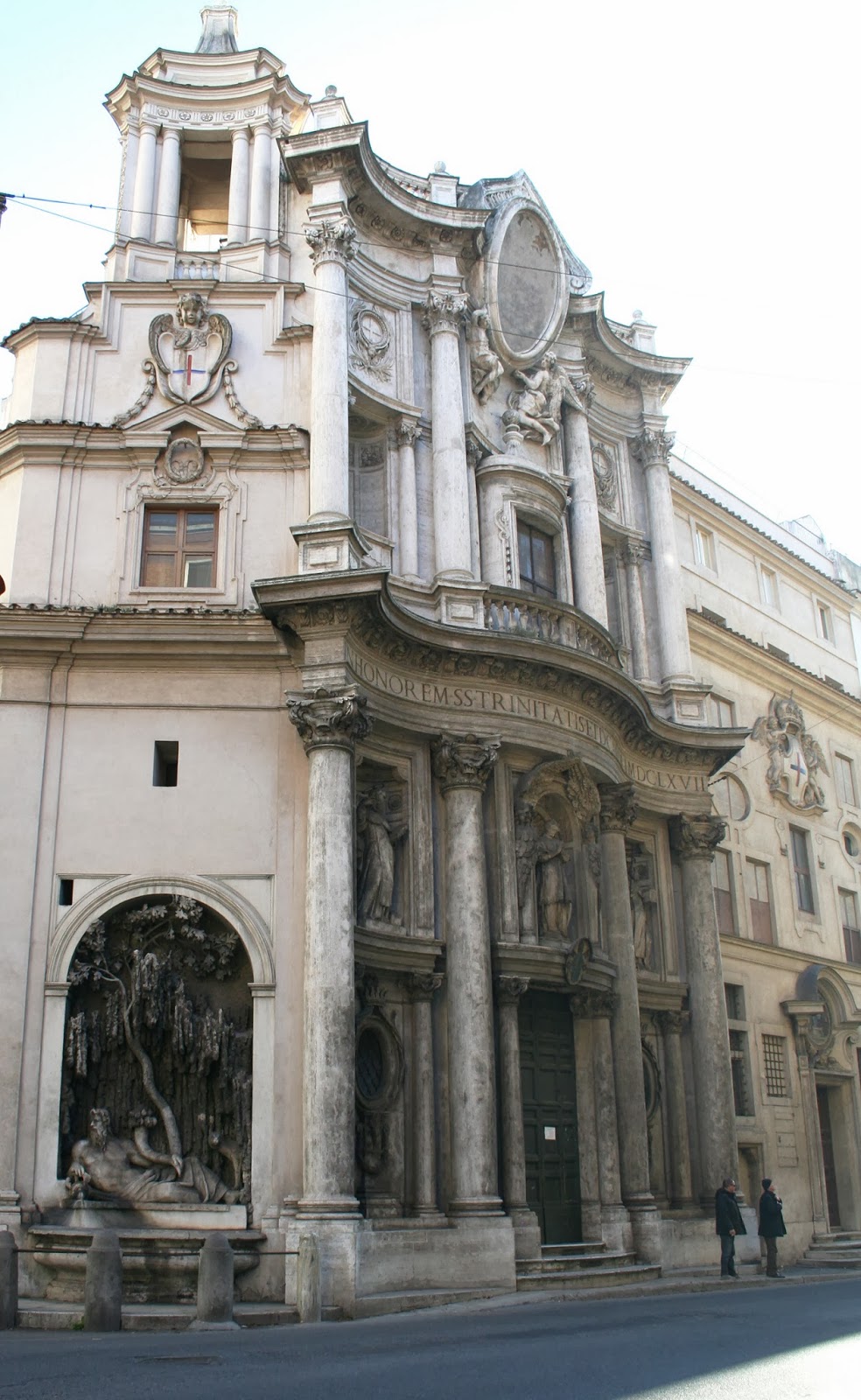
San Carlo Alle Quattro Fontane

This is one of Borromini’s masterworks and the one building in Rome that I was most looking forward to seeing. It did not disappoint. I was, in fact, moved to tears. As advertised, the building is tiny, but no less impressive for it. This was not the grandest space we saw, nor was it the most modest, but God was in that place. It is rare that the genuine physical article surpasses expectations bred of imagination and anticipation, but oh the joy of experiencing those moments.


Sant’Andrea Al Quirinale

This was the Bernini building that I was most looking forward to. Unfortunately for me, the interior was closed for restoration. I can’t blame Bernini, but this building held his best chance to win me over.


S. Ivo Della Sapienza 
This Borromini building had a profound effect on me. The church is only open once a week, for Mass on Sundays. The four-day wait to see the interior added an element of delayed gratification. The exterior, however, was more accessible. S. Ivo was a couple of blocks or away from our hotel, and we had a great view of the unique spiral lantern from our balcony. The approach to the church is open, and starts with a normal door in a rather normal building façade opening into a two-story, colonnaded cloister (designed by della Porta).  That Sunday morning, I woke up bright and early, put on my Sunday best and walked by myself to the church. The weather was perfect- sunny, crisp and clear. Having arrived early, I was gifted a few moments to sit and reflect. When the doors were opened, I had the place to myself. I passed through della Porta’s cloister and into Borromini’s sacred space. Sacred is the best description I can offer. It is one of those places that makes you feel. It is a place of adjectives- awe, wonder, quiet, power, love. Out of respect for the parishioners who would soon arrive for worship, I did not tarry. But I will never forget the few minutes I had alone in Sant’Ivo.

Il Gesu

As the first full-blown Baroque church, I pretty much had to go see Il Gesu. Was I particularly excited about the work of Vignola and della Porta? Eh, not really. It was, however, a very pleasant surprise. It is exactly what you think a Baroque church would be- effusive, ebullient, and over-the-top. Normally, that stuff doesn’t move me, but there was no denying the force of this work. The ceiling fresco is absolutely stunning and is one of the most memorable surprises of the trip. The link to Bernini/Borromini is tenuous at best – Bernini sculpted a bust in the presbytery.
St. Peter’s Basilica

With respect to the Rose Bowl, this is the Granddaddy of them all. This is the biggest and grandest  church in the world. It is undeniably impressive, and adjectives don’t do it justice. It’s impossible not to be moved this remarkable edifice.  As impressive as the structure is, I am enthralled by the history of its construction. Over the course of 160 years, the plan was conceived by Bramante, fiddled with by lesser minds, rectified by Michelangelo, carried on by della Porta, (unfortunately) extended by Maderno, and tricked out by Bernini (with the help of one Francesco Borromini). This is a truly fascinating story about the relationships between architects, other architects, their clients (Popes), and how projects evolve over time. If you don’t know it, treat yourself.
 

Hmm, would we rather see Maderno's facade or
Michelangelo's dome?
Don't let the picture fool you. At 98'
The baldacchino is as tall our
Aquarium's Ocean Journey.
How big is it? If you stacked the Suntrust
Building on top of the Volunteer Building,
they would both fit under St. Peter's dome.
(With 2 feet to spare)
The Pantheon

This building is 1,888 years old. One thousand eight hundred and eighty eight years old. It was originally a tribute to seven Roman gods, but was later converted to a Christian church. This conversion was fortunate for us, since it meant that the interior was never looted and remains much the same as it was 1,888 years ago (that’s almost two millennia to you and me). However, bronze from the portico was stripped, melted and used for the baldachin at St. Peter’s (yes, the same baldachin on which Bernini and Borromini collaborated). The Pantheon is truly remarkable. As it was on the doorstep of the hotel, it served as a constant backdrop for the trip. I enjoyed this building immensely.
That would be the largest un-reinforced
concrete dome ever created.
The buildings listed in this post are some of my favorites, but they only begin to describe the great buildings we saw. Notable omissions include Santa Maria Della Pace, Santa Maria Maggiore, Sant’Agnese in Agone, Oratorio dei Filippini, S. Giovanni dei Fiorentini, the Tempietto, and all of the ancient works.
As if I wasn't going to drop some
Tempietto on you.
As for the dueling B’s, I found that the work of Borromini moved me to a far greater extent than his rival. Bernini’s built work is too “safe” and static for my tastes. That said, his sculptural work is absolutely breathtaking. In fact, his Apollo and Daphne at the Borghese may be the greatest sculptural work I have ever seen (but, it’s tough to say that after having also seen his David and The Rape of Prosepina in the same gallery).

Have a great week. Next week, hopefully we’ll get back to issues closer to home.

12.30.2013

All Roads Lead From Rome - Part II

I owe all of ya’ll a belated Merry Christmas and very best wishes for a Happy New Year. This week, part two of my very scattered, and random thoughts from a recent trip to Rome. It became immediately apparent that I was not capable of crafting a comprehensive review of Roman streets in a thousands words. I know I'm missing some major points and observations, but the weekly deadline waits for no man. Time's up, pencils down...

Via del Corso on a Saturday night.
Time is a funny thing. I’ve been back for less than two weeks, but with Christmas festivities sandwiched in between, it feels like months since we were in the Eternal City. This week’s post is about roads, but it’s also about time. Their incremental development over millennia has created a street system that stands in stark contrast to what we experience. This portion of their public realm is clearly a societal institution. People love the streets and piazzas, and they are integral parts of how life is lived. At first glance, their street system seems disorganized, haphazard and substandard by our measure.  Closer investigation, however, reveals that their system is more sophisticated and urbane than anything we have to offer.

Via Frattina
The obvious remark is that Roman streets are shared spaces. Yes, there are places that shade either more car or pedestrian, but there is a broad gradient in betwixt. Even along the same street, the character changes and fluctuates (Via del Corso being an excellent example). Over here when we talk streets, we talk cars- then everything else. Over there, cars abound, but they are only part of the larger conversation (if not an afterthought).

Nova Via. A rather old street.
Rome was founded around 750 BC- that’s about three thousand years ago in round numbers. As a place that eventually became the greatest city in human history, tremendous development pressure was put on every square inch of space in the urban area. This led to a naturally integrated system of streets of and piazzas that was human in scale, and that addressed transportation needs while deferring to the greater activities of life in the city. When the car made its appearance, it was subjugated to the weigh of civic form. The intersection of history and new technology created a distinctive set of circumstances.

Via dei Condotti from Piazza di Spagna
For 97% of their existence, the primary mode of transportation has been the shoe. Obviously, the streets and piazzas of antiquity weren’t dimensioned with automobiles in mind. To utilize new technologies they had find ways to shoehorn them in to the existing fabric. An example of that is the proliferation of one-way streets. In the states, one-way streets are (thankfully) coming under scrutiny, but they work in Rome because that is their only option (and ain’t nobody speeding down a crooked eight-foot wide cobblestone path anyway).


Over here, we love spatial segregation. Streets are streets, plazas are plazas, parks are parks, and parking lots are parking lots. People in one place, trees in one place, bikes in one place, and cars in another. None shall mingle. Over there, streets and piazzas are funky combinations of people, bikes, cars, architecture, food and open space. Often, a piazza is simply a slightly widened portion of a street in front of a building. This is as it should be. The life of the city, of the buildings, and of the open spaces where people live, work and play is given precedence over how people move from activity to activity. This system can best be described as civilized.

The guy with the baby stroller would be arrested in America.
The contrast in systems goes beyond physical form, it extends to operation as well. The American system is like an official game of basketball, while the Roman system is more like a pick-up game. Over here, there are explicit rules for everything. “The game” is closely officiated, score, stats and fouls are kept, and the players all abide within that framework. Over there, rules definitely exist, but there is informality in how they are applied, and the players often take liberties with their interpretation of the rules.


Take, for instance, that act of street crossing. If you want to cross Market Street, you find an intersection and wait for a light. From there, simple rules apply to both pedestrian and driver. In Rome, on several streets with a similar sections (it’s tough to say as individual lanes aren’t generally marked, only the centerlines), signalized intersections don’t always exist, and crossings are made at crosswalks. To cross, you take your life in your hands decide when to cross, and essentially walk into oncoming traffic. As if by magic, the oncoming cars stop, slow or swerve to allow pedestrians to pass. This is (literally) a foreign concept to an American, but one that seems to work fine. In fact, it works better than fine. Their system is respectful of pedestrians and puts people and cars on more or less equal footing.  Our system treats pedestrians as nuisances to be grudgingly dealt with during the task of moving cars.


The Roman public realm is driven by civic agreement. In fact, they fulfill the promise of the concept- it is truly shared space. We, on the other hand, are selfish, no matter which mode we choose. Our transportation system is designed for a group of spoiled young children who can’t play together without having a referee (police) or chaperone (lawyer) supervising the action. They drive like maniacs, yet are patient and respectful of pedestrians. Their pedestrians are bold and entitled, yet make concessions for cars, trucks and transit. While at first glance their system is chaotic and disorderly, it is at its core sophisticated and civilized. Our system is segregated, and therefore adversarial. So, while we have a long way to go, the good news is that we have another 2,800 years to work on it.

12.23.2013

All Roads Lead From Rome

Buongiorno amici, It’s good to be back with you after taking a couple of weeks off. As you may recall, in a previous post I pledged to leave the country if the unthinkable happened. It did and I did. To rub salt in the wound, on the following Monday I received a form letter from the Auburn Fund asking for a donation. Unfortunately, the levels of giving did not include “Kiss my Ass”. I have, however, recovered from my bitterness and have managed to do so without resigning my post on the Alumni Advisory Council. We'll get 'em next year.

As “All roads lead to Rome”*, I could think of no better place to gain a bit of perspective than the Eternal City. It’s probably too early to say, but Rome may have replaced NYC as my favorite city. I lack the vocabulary to describe just how remarkable the place is, but will share with you my impressions of the city. I’ve tried over the past couple of days to craft a cohesive narrative, but find that the task is beyond my capacity. The best I can do is offer my thoughts loosely grouped into the categories of public space, roads and architecture. This week, my take on public space.

The morning view from the hotel did not suck.

I suppose we should start outside the hotel door at the Piazza della Rotonda. I chose our spot because of its central location in the city and  of the hotel, but I was primarily seduced by the fact that it was mere feet from the Pantheon (more on that in a few weeks). While I was excited about the architecture, I did not expect that the piazza would become a favorite place. The space is a little more than half the size of a football field, is fronted on the south by the aforementioned Pantheon and on the other three sides by five and six story buildings. Each of the buildings has ground floor café/restaurants that spill into the space. The fountain, in the middle of the piazza, was designed by Della Porta and is topped with an Egyptian obelisk (dating from Ramses II). There were always people in the piazza- wandering, lingering, or having a drink in a café. The space is welcoming, comfortable, impressive and inspiring all at the same time. Dodgy guitar players notwithstanding, I loved that space. It fit like a well-worn, favorite shirt.

Robert Plant Memorial Sqaure Piazza della Rotonda

A young man who set up camp in the Piazza each day provided the soundtrack for our trip. He was an electric guitar player who knows only two songs: Pink Floyd’s “Wish You Were Here” and Led Zeppelin’s “Stairway to Heaven”. He played those songs back to back… to back to back from 9am until 11pm every day. All day. Every. Day. I used to love those songs. 


Scalinata della Trinità dei Monti. Hey...is that an obelisk?

The Spanish Steps were pretty cool. We made it past a few times and there were always hordes of folks loitering and milling about. I will admit however, that with everything else to see, I couldn’t be bothered to take too much time to linger. That said, I could definitely see the attraction. Although I thought I knew the site pretty well, I did experience it in a unexpected way- but I’ll save that for next week. The thing about the steps is that they are a sterling example of using a site constraint (in this case topography), to advantage in creating something that has civic value. Considering the current state of affairs in Chattanooga, do you think we would be more likely to build a “Spanish Steps”, or to build a big ass wall because it would be cheaper?

Fontana di Trevi. I forgot to throw coins in, damnit.

The Trevi Fountain was fine. We stopped by once for about 10 minutes. The sculpture of the fountain was impressive as was the spatial character of the piazza. My memory of the place is that the mob of people who were there to see the fountain was overwhelmed by the mob of those trying to sell things to the people who were there to see the fountain. Speaking of people hawking cheap wares…

Borromini v. Bernini
Borromini v. Bernini v. Gatlinburg
They also have (a Roman copy of) an obelisk.

Our experiences are greatly colored by our expectations, and I had very high hopes for Piazza Navona. I was disappointed. This public space has been around for millennia, dating back to its life as the Stadium of Domitian. This has been a gathering place for Romans and a center of civic life for two thousand years. The piazza boasts one of the most famous fountains in the world- Bernini’s Four Rivers Fountain- topped with the de rigueur obelisk. The piazza is also home to one of Borromini’s masterworks, Sant'Agnese in Agone (more on Borromini v. Bernini in a few weeks). I prepared myself to be blown away by baroque and historic forces, and was somewhat let down. The fountains and buildings were as good as advertised; the space however, was jacked. The best description I can muster is that if Panama City, Gatlinburg and a state fair had a ménage a trois, the resulting lovechild would look like this. Perhaps, that's a bit harsh, but everything within the space was pure schlock. The fact that it happens in such a grand setting makes it feel worse. That said, for the couple of precious moments that I could manage to dodge the gypsies, shut my ears, and keep and my eyes above the ground floor, it was a beautiful experience in a well-proportioned space. The heartening thing is that all the crap could easily be swept out of the piazza at any time, thereby restoring the dignity of the place. It’s not as if their community constructed a bunch of one-story, casual dining and hot wing restaurants- who would ever do that…oops.

Piazza del Popolo: Better than anything you've got.
A three thousand year old obelisk...whatev.

Piazza Del Popolo is one of the most impressive public spaces I’ve ever been in. If this space were in any other city in the world, it would be that city’s greatest public space. In Rome, however, it’s arguably the sixth most significant place (behind Piazza Navona, the Spanish Steps, Trevi Fountain, the Campidoglio, and St. Peter’s Square). The piazza, once the major northern gateway into the city is a large oval. Three main roads radiate from the piazza into the city. The “twin” churches of Santa Maria dei Miracoli and Santa Maria in Montesanto occupy the two spaces between the roads. In the center of the piazza is (yawn) obelisco Flaminio, an Egyptian obelisk dating from Sety I. Popolo is larger than Rotonda, and the fact the edges are sculptural instead of active building make the piazza feel more expansive and formal. I really liked it here, and not just because of the Cuban cigar and Nastro Azzurro.

The world's greatest public space.
Child please, my obelisk is 4,400 years old.

As arguably the greatest public space ever created by the hand of man, I had high expectations for Piazza San Pietro. I was let down, but only slighty. The space is grand and awe-inspiring. Unfortunately, for yours truly, a potion of Bernini’s portico was behind scaffolding, and the piazza itself was full of chairs, barricades and T.V. screens in preparation for Christmas events. While it was bad luck for me, it was not quite the kind of let down that Piazza Navona was. The formality of the space is a direct result of rigid symmetry and axiality, and is reinforced by Bernini’s arcade and Maderno’s façade. Did you think it would not include an Egyptian obelisk? This one dates from the Fifth Dynasty (that’s 2400BC to you and me). There are no cafes or active ground floors around the piazza- it doesn’t need them. The space is undeniably about people, but whereas the other spaces I’ve highlighted are about community and the social nature of the individual, this space is about the relationship of the individual to God. It is about people, and society, but it is imbued with greater meaning. This is a truly great space, in every sense of the word. Sadly (wink), because of the visual clutter during my recent visit, I have no choice but to return and see it again.

To try contrast Chattanooga and Rome would be silly and unfair. However, the clear takeaway from a public space standpoint is that we suffer from an appalling lack of obelisks. I could have written more (most notably the Campidoglio), but space here is limited and I know you're dying to read the latest about Duck Dynasty. So, arrivederci for now. Next week, the roads of Rome!

*A little trivia: I was informed by an archaeologist that the old saying was actually “All roads lead from Rome”.